GPs must treat foreigners under new guidelines | Mail Online

I first saw the following headline as I passed the Newspaper display in my local supermarket, and halted my chair in shock! The following is from the Daily Mail, on the 13/10/12. Click the following link to read the article: GPs must treat foreigners under new guidelines | Mail Online.

I have no doubt we will hear much story in the coming days, from every possible angle. However, as someone with a long-term illness and a long-term disability, I am astounded that such a decision could be reached while leaving common sense at the door. For m, this one is the latest in a list of CRAZY decisions about the NHS… and we have to take action while we can. Id love to know what you all think of this decision.

‘Dave’s’ speech (2)

This is the second of two posts on two David Cameron’s Closing speech to the Consevative Party Conference delegates. The first is concerned with Cameron’s take the Paralympics, and people’s view of disability. In his speech Cameron also talked about something called “Compassionate Conservatism” and said that they were providing for vulnerable people.

Sorry ‘Dave’ but you don’t have a clue mate!

What does ‘Compassionate’ Conservatism actually mean? Is it just to make them sound better? From where I’m sitting there’s not a lot of compassion. Yes, Dave, I understand that you think you understand, but having one disabled child does not mean you understand what it’s like to live day my day with a long-term illness or disability. I’ve had a disability for almost 30 years, and been ill for at least the last 10, and there’s so much I don’t yet know about disability. For example, I couldn’t pretend to know what it’s like to live with even a moderate learning disability. Also, when Ivan was alive, the Cameron’s won’t have been at the mercy of the complexities of the welfare state. Most problems are easier if you have money to chuck to chuck at it, including the provision of high quality specialist care.

As far as I can tell, the conservatives have this idea in their heads that they are providing for those in ‘genuine need’ and so being compassionate, while encouraging everyone else, to get a job, which they think is best, as work, rather than benefits pay, and so they are being compassionate. The reality is that it is not just the Ivan’s of this world who are unable to work. It is quite right that people who have his level of disability should be given the very best, but can the country afford it? There is a complex mixture of people who are unable to work, but the benefits system is too inflexible to recognise this. As a dear friend said recently, it is impossible to compare two people, even those with the ‘same’ condition/impairment, or a ‘similar’ level of disability, but for the purposes of doling out finite resources, there needs to be a way found of comparing people with money being distributed as fairly as possible. Yes, an absolute minefield!

Even where one does qualify for what is called the ‘support’ group of Employment and Support Allowance (ESA) as I do, the form is a peculiarity in itself, as it is designed to trip people up, and the system is designed to recognise specific words and phrases as being associate with corresponding levels of need, and so it is best for the claimant if they fill in the form with someone beside them who knows what these specific words and phrases are and who can arrange the wording accordingly. I have been filling in forms for government since I was 18, and even with two degrees, I required the help of a friend who hold a senior position at a local social enterprise to be able to fill the form in correctly. My friend asked me for absolutely minute detail. For example, where was the pain, how long does it last, how often does it occur, how severe is it. which tablets help, and how much of the pain do the tablets take away. What are the side effects I suffer from of the pain relieving medication, and how does one medicine interact with the other. We had to do this for every place I have pain. When writing about how the fatigue affects me day to day we had to write in similar detail, for example, how often does it confine me to bed; how often does it limit my level of activity, and in what way? What impact did this have on my mental wellbeing. It was the same with the problems with my ileostomy bag, other medical ailments, how my cerebral palsy affects my mobility, dexterity, how my independence has been gradually chipped away… and the rest! We ended up with at least three double-sided blank pages of closely written extra information. The whole exercise took the best part of three hours, and left me utterly exhausted. When my friend left, I took to my bed for the rest of the day!

The form also required me to list every professional I see, and at the time I think I had a list of about fourteen! Every time I lose one, there is usually another to replace them! Not only this, but all the names and address and phone numbers of each of the team of people. It was the same for each subsequent question; so much was required. Even then, I was at the mercy of someone reading all this information who was able to process it all and understand the impact of everything on my daily life, and which group this placed me in. Obviously as a Christian, I prayed before the form was posted that such a person who be the one to assess my level of need. You might think that all this effort may entitle me to support for at least a year or two…. wrong!!

Compassion?! What Compassion?

Every time the benefits system is altered I am at its mercy. There are new forms to fill in, new benchmarks for the different levels of need, and fresh understanding required to fill in each form. To be constantly required to use my precious limited energy on all of this is, for me, a hallmark of a lack of compassion, and also, a pointless exercise, as it means telling the Job centre or Department for Work and Pensions, who they already ought to know. I understand that they have to know who is in need tobe able to determine who is not, but it is not as simple as this, and therefore, one system does not fit all… therefore even the very words universal Credit strikes fear in my heart. As I have described in some detail, it is hardly possible for one system fit all, as each individual’s level of need varies, and yet to “make work pay” it has been deemed necessary to lump those who are not working together. From next April, the reassessment fun will begin again, twice over, for “Universal Credit” and for the new Personal Independence Payment (PIP) which replaces Disability Living Allowance (DLA).

Every time the system changes, so does my income as I am entirely dependent on the state. Obviously as a Christian who attempts to live out her faith on a daily basis, I know, and have to trust my heavenly Father that he knows what I need and will provide. This week, I lead a bible study focusing on the first four chapters of the book of Esther. This book is about a women who battled with her circumstances, and won, with the help of her God. An appropriate study for me to lead, as it turned out, because the opening question asked which factors in each of our lives we out with our control, and how did it affect us. Of course, the natural answer for me, aside from my illness and disabilities (impairments) is my level of income. This was something of an eye opener for the group, who being caring people began to feel sorry for me as say things like “but surely this does not affect you?” the assumption being that I would quality for support with ease, and so not have anything to worry about. Once I explained, however, that the system changed regularly, and with it my level of income, they understood that this was indeed something out with my control, and therefore something I had to trust the Lord with. They had compassion.

The One with the MP

A number of months ago, as the forthcoming changes were being first discussed, I was, naturally unsure what the changes would mean for me personally. One Saturday, as I was in my local supermarket, I noticed my MP was holding a surgery, so I duly waited in line. My MP listen intently to my story and my questions, as an intern or assistant took notices, and tried to understand my situation. He assured me, as Liberal Democrat, that he was prepared to stand up for sick and disabled people in his constituency, and he would be seeking assurances from his colleagues in Government, that people like me with a genuine need would be provided for. As promised, he wrote to the then Minister for Disabled People, Maria Miller, seeking assurances to that effect. Ms Miller’s answer to my MP was a clearly photocopied stock answer which parroted out the propaganda now associate with this Conservative government, that the forthcoming changes with necessary in order to encourage disabled people, of which I was one, into work, with no acknowledgement that there would be those who could not work, however much they might like to. One had compassion, the other did not. I will leave it to you, to decide which!

What does the Bible say about ‘Compassion?

There are many reasons for the current Government’s lack of compassion, some of which I have outlined above, and partly springs from a lack of understanding and from not knowing the everyday reality of life for someone like me. However, their very understanding of ‘compassion’ may be questioned. In his speech. Cameron was talking about a type of compassion, compassionate conservatism. Surely if they were truly compassionate this would be apparent in every policy this government introduced. however, as I have explained, I am doubtful that the current Government even understands what ‘compassion’ is. I am privileged to know One who does know what compassion means, and that’s the Lord Jesus. There are many scriptures I could quote here, but the one that came to mind first was when Jesus fed the five thousand.

Jesus called his disciples to him and said, “I have compassion for these people; they have already been with me three days and have nothing to eat. I do not want to send them away hungry, or they may collapse on the way. (Mathew 15:32 NIV)

Here, Jesus saw a need he could meet, and dud so, out of the abundance of his love for the people. It may sound obvious, but hungry people need food, In this country, there are people going hungry who do not have food. One example of an organisation trying to meet these needs is the Trussell Trust, who say “Rising costs of food and fuel combined with static income, high unemployment and changes to benefits are causing more and more people to come to foodbanks for help.”If the Government is compassionate, why are people going hungry? To me, this is yet another illustration that they do not know the extent of the need in their own country.
‘Dave’s’ speech, (1)

Dave’s speech, and the ‘legacy’ of the Paralympics

David Cameron’s closing speech to the conservative party conference has already been talked of and analysed a great deal. I would like to chip in my pennyworth. I started to write about two of the main subjects of David Cameron’s (‘Dave’ to you and me) closing speech to the Conservative Party Conference: The ‘legacy of Paralympics; and something called ‘Compassionate Conservatism’. However, there was so much to discuss I have split it into two posts.


‘see the boy, not the wheelchair’

Regarding what Cameron had to say about disabled people and the much talked of ‘legacy’ of the Paralympics,  he talked of both sporting achievement and the change the games made to how disabled people in this country are viewed. To illustrate the latter, he talked of his late son, Ivan and how [he] “always thought that some people saw the wheelchair not the boy. Today more people would see the boy and not the wheelchair, and that’s because of what happened here this summer”.

Others including those who were responsible for bring the games into being shared Cameron’s view. “Paralympic organisers hailed “the seismic effect in shifting public attitudes” to disability sports claiming the Games had changed public perception of disabled people forever”. (The Independent – 14th September 2012) I agree with Cameron to an extent, but not with the sweeping statement from the organising committee!

The Paralympics did indeed change some people’s attitude to disability, and disabled people, especially the younger generation, which I wrote about a few months ago. It makes for an interesting read, and shows that there is hope you the future, if the legacy is handled correctly, but really, have we seen much evidence of that so far? The general public’s view of disabled people may have changed superficially, but a lot more work needs to be done.


‘Hate crime’ and the Paralympics

In an article in the Independent from the 14th September 2012 talking about the link between a dramatic rise in hate crimes against disabled people, Scope, a charity working with and for disabled people said:

“Our polling has shown that attitudes towards disabled people have deteriorated over recent years and that many disabled people experience harassment, hostility and abuse on a regular basis. We know if unchallenged these low-level incidents can often escalate into more serious crimes. “

There is a clear disparity here between perception and reality. Until Cameron can be more realistic about the reality of what disabled people face in their everyday lives, little is likely to change.

In the same speech, Cameron talked about how the Paralympics enabled people to dream of achieving things in sport and to be Paralympians. However, this is not realistic for the majority of disabled people.  As far as I’m concerned,, some of it was rhetoric designed to justify budget cuts. It’s like saying, if the Paralympians are achieve great things, then so can most other disabled people, therefore anyone who doesn’t is not trying hard enough, therefore, if you don’t try harder to achieve, your benefits will be cut. For me, some days just being up, dressed and medicated is an ‘achievement’ in itself, and the effort of which can and does send me back to sleep. This happens despite having carer’s help to do all these things.

Also, when he talking about how their should not be any barriers to achievement, and named a number of groups of marginalised people, and said none of these groups should be stopped from achieving, but he did not include disabled people when claiming the Conservatives were the people’s party!

“My mission since the day I become [Toy] leader was to show the Conservative Party is for everyone: north or south, black or white, straight or gay”

As with the public’s attitude to disabled people, more work is needed before disabled people have the same opportunities as others, and would then be free to ‘aspire; to whatever they wanted to, including Paralympic sport!

A word of encouragement…

Noticeable through absence!…

As yet, as far as I remember, I haven’t yet blogged specifically about my faith, or faith in general. There are couple of notable exceptions such as when I blogged about my “health story” and referred to the way God has sustained me and been my strength. The other time is when I highlighted the plight of Rimsha, the girl in Pakistan who has been persecuted for her faith. I encourage you to continue to pray for her, and visit the website for “Open Doors” for updates. 

The Jesus bit

I read something yesterday which I would like to share. I use some Bible Reading notes published by the Good book company, called “Explore”. Yesterday, the main passage was from Luke 23: 2-12, talking about how Innocent Jesus was, and is. Especially in comparison to us, Obviously it was His Innocence that made him sinless, and therefore eligible to be the sacrificial Lamb on our behalf to atone for our sins. This is something we ought to take time to thank Jesus for. This also means that because of Jesus sinless-ness, and his sacrifice, we can be cleansed form our sin, and are made clean, and new. As new creations, we are given new garments to wear. Galatians 3 26-27. I am reminded of how good new clothes feel, especially if they are posh new clothes. They make me feel good, look good and I don’t want to do anything to spoil them so I try my hardest not to spill anything on them or soil them in any way. It should be the same with the “new clothes” Jesus  gives us. We should be determined not to do anything to dirty them in any way. This means that as well as turning from old sins, our thought-lives should also be renewed. “transformed, by the renewing of our minds”. This means you (and me!) should “set your hearts on things above, where Christ is, seated at the right hand of God. Set your minds on things above, not on earthly things. (Colossians 3:1-2, also see v 3 and 4). What are the ‘things above’ we should be thinking of?

Finally, brothers and sisters, whatever is true, whatever is noble, whatever is right, whatever is pure, whatever is lovely, whatever is admirable—if anything is excellent or praiseworthy—think about such things. (Philippians 4:8)


What a challenge! Fortunately we do not have to do these things in our own strength with with His help and by His power. I hope these verses encourage you as you go through your day today.

‘New door has opened’ with robotic exoskeleton – Channel 4 News


Paying a premium to feel ‘normal’

I’d like to encourage you to follow the link below to the video and article by Sophie Morgan, one of the presenters of Channel 4’s paralympics coverage, as she trials something called an exoskeleton. It’s incredibly moving, as you might expect, but also shows both what can be achieved through technology and also what it’s limitations are. It highlights the limitations of most ‘specialist technology, such as prohibitive cost.


New door has opened’ with robotic exoskeleton – Channel 4 News.


However, the freedom that this robot provides raises interesting questions, as for people with an aquired disability it gives people something of what they had lost, albeit primitive, until the technology develops. One of the dangers of this type of technology is that is reinforces current stereotypes, that to walk is normal, and to wheel is an inadequate alternative only suffered by those who have no other choice. This is something which Morgan herself alludes to.


what has happened, in effect, is that a new door has opened to a world where, despite my disability, I can still have the freedom of standing and moving, but that the condition I have adapted to doesn’t need to change.


This approach highlights the potential problem, as standing and walking equate to freedom, despite Morgan being “comfortable” with being in a wheelchair. The potential dander then is, that to be in a chair effectively means your body is in a prison, or at least that to use wheels is the poor cousin to walking, and therefore being independent, and ‘normal’, although it is interesting that Morgan denies some of this.


The final quote from Morgan immediately brings more than one Bible passage to mind. (Apologies to those who consider me to be bible-bashing!) Morgan says that perhaps one day “ill [sic] be jogging down Brighton beach with an exoskeleton robot under my trousers and my wheelchair in the skip!!” The truth is of course, that for those who turn to Jesus, one day we really will be jogging, and our wheelchairs will be in the skip. We will have a freedom far beyond what any robot can provide, however ‘advanced’ it is. That said, this is an interesting development which I look forward to following.


Get ready for work: what woman who needs constant care was told | Society | The Guardian

The Mind boggles:

HOW could an ATOS medical have declared this lady fit for work? It’s just horrifying. Surely she should have been exempt from a medical, having qualified by gaining 15 points on the first question that asks how your disability affects you, or in this case how it affects the person who the benefit is being claimed on behalf of?! Even if that were not the case, one look at Ruth says she’s not capable of work! Here’s the link to the article, and interview with Ruth’s mother:

Get ready for work: what woman who needs constant care was told | Society | The Guardian.

“I am blaming the system that allows people with disability to be targeted, to be made to feel as if they are a burden on society” (Ruth’s mother).

This should NEVER happen again, BUT…

It’s incredibly heartbreaking to watch the video.  Ruth should be betting the best of everything, not being held ransom to unrealistic targets. Anyone with two brain cells can see that surely? Kudos to Ruth’s mother for remaining dignified throughout the interview with the guarding, and for her love and compassion for her daughter. She too, should be helped and supported, not subjected to further demands. How has this government got it SO wrong? I don’t want to say too much more and detract from Ruth’s story. It is one that deserves to be heard, and acted upon urgently so that nothing of this nature happens again. However, I fear the people who most need to listen are the last people who will.

Are you ready?

My latest #digidisciple post is now LIVE!

I’ve written another post for Big Bible. This time it’s on the theme of #story. More specifically, evangelism and sharing my personal Jesus-story. Here’s the link: Are you ready? I’d love to know your thoughts. If you have any suggests of other ways of sharing faith online, I’d love to hear those too! 🙂

BBC News – Paralympics 2012: How do people view the wheelchair?

BBC News – Paralympics 2012: How do people view the wheelchair?.

I have been meaning to comment on this excellent video for some time now. In the audio John Hockenberry asks a couple of pertinent questions which, while he provides sparking answers, also provide room for debate. The first is this:

Those exact same elements that might put you off are transformed in the Paralympics. Why? 

It is question of identity,  centered around how we see the “other”, those who are different from our perceptions of normal. Also, where we see the person may alter the image, so not just the body, but also the environment. As he says, it is a case of allowing one image, that which our subconscious has been trained by the media, our nurture, and stereotypes to be seen as tragic, we allow to become triumph. This also explains our potential reaction to any of the pictures in the photographic article The 33 most inspiring photos of the Paralympics. (I have also offered my own comment on the images in my previous blog post.)

This would be the case not only for the person or people looking on, but also for the disabled person themselves. How does their disability alter their view of themselves. I can only speak for myself in this. For me, this such a huge question.; From tragedy to triumph. I have partly answered the question before, in explaining how difficult it ws to come to terms with the consequences of major surgery, but this question also applies to how I view myself as a person with cerebral palsy and as an electric wheelchair user. As I explained in the same article, being told I use a wheelchair full-time, for me, really was a tragedy and one I am coming to terms with. In terms of how it affect my self-image, I feel it makes me look somehow vulnerable, in some ways more disabled than I am, as I am able to mobilise a bit.  Both how I view myself, and how others view me depends on which aid I am using, amongst other things. If I use my electric wheelchair, and my environment allows me to use that chair unaided, I have a sense of freedom I do not have at any other time, as I can decide where I want to go, when, and for how long. Put me in my self-propelled wheelchair however, and it’s a different story. Then, I do not have the same freedom. Recently, mu manual chair was being fixed, and I’d gone to a local gym in a taxi with my Zimmer frame, and a carer. After the usual pleasantries, somehow I blurted out how I wouldn’t be so fine after my swim, having had the exertion of walking from the house to the taxi, the taxi into the gym etc. Her response was incredibly thought provoking. She exclaimed in surprise, “Of course, where’s your wheelchair? You looked so natural walking out of the lift that I hadn’t given it a second thought!” This is party about one way of mobilising being normal, and the other, abnormal, natural vs unnatural. Also, somehow on my feet with the Zimmer at least, I feel taller, and don’t look “disabled” as such. That is, until I wobble backwards, or tire, which happens after a few steps. This particular incident has really got me thinking though. With the Zimmer, however I may look more ‘normal’ but I do not have any of the same freedom as I do the majority of the time in my electric wheelchair. I have to be having a ‘good’ day, both in terms of pain and energy levels, and be somewhere “barrier-free”. A different environment, and it’s a different story.

The tragedy… gets trumped by the intent. When you see the athletes using their bodies and equipment, not being used by it, it changes everything.

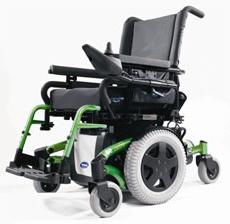
My electric wheelchair is definitely the mobility aid which allows me to use the most ‘intent’; the wheelchair has a purpose. Like I say, I dictate where I go, without depending on another. I might not have as much leg function as I used to, but it hardly matters in my ‘go faster stripes’ wheelchair! (mine is similar to the one below, although the frame is black rather than this fetching lime green model, and I have extra cushions!)

So, what else does John Hockenberry have to say about the ‘wheeliechair’? He goes on to describe is as “an alternative to walking, not some shameful and inadequate substitute”. WOW. i guess I would find that easier to identify with if I saw a Paralympian such as Hannah Cockroft propelling her chair in the street, than I can use this phrase for myself. It’s  different too, having walked  for the majority of the previous 28 years. However, I have to learn to see myself as the “agent, not the victim”. I’m sorry if this sounds like I’m labouring the same point. I find this video, and the words Hockenberry uses so powerful and transformative, we are participating and whatever caused my disability, or that of anyone I see in the street is “way back there, way back at the starting line!” 

This view of the wheelchair, and other ‘aids’ has the power to turn stereotypes upside down. however, some of this depends on the look of a product, and the design of it, as well as it’s function. An organisation called Enabled by Design, for example, feature reviews of products, ‘specialist’, or not. I have read several articles on the importance of the design of aids and adaptations. These of course cost money, which is what Disability Living Allowance helps to compensate for. They should be just that, something which assists us, and more readily available, as opposed to often prohibitive costs, which would enable more people to be agents, and not victims. It is about more than identity, and the way others view us, but also whether aids are ‘sparkly’ enough! I’m all for sparkly chairs!

I’d love to know what you think of the video, how you view disabled people when you see them in the street, or the design of aids in general.

What’s the difference between ‘free speech’ and the need to prosecute?

BBC News – DPP Keir Starmer on social media prosecutions.

It’s well known that whatever we use technology for, and whatever we type is recorded, whether that be text messages, status updates, tweets. There is so much surveillance and such a need to be careful what we say. There is also obviously a danger, that social media could become stunted somehow if the line were drawn in the wrong place. Here DPP Keir Starmer’s thoughts by clicking on the link above.  I wanted to bring it to people’s attention. I bet it will be today’s ‘hot potato though in terms of ‘new’ news, in amongst the awful things that have happened recently. Would love to know what everyone thinks of this story.

The 33 Most Inspiring Photos Of The Paralympics

The 33 Most Inspiring Photos Of The Paralympics.

Apologies for the lateness of this post! However, I felt it was still worth commenting on these pictures. There’s so many “where were you when…?” moments that there’s something for everyone. It’s also I think, the trumphant smile, or act of celebration you see first, before you see the person’s disability. However, some people find that kind of rhetoric harmful, as it somehow normalises the person…. and who, or what is “normal”. It does however subvert the stereotype of disability as something to be feared, to be ignored, or always seeen negatively.

Also there has been so much focus on the triumph, and not just a lot of focus on the legacy. I have seen various paralympians on variuos TV chat-shows and daytime shows. It has also been interesting watching the althletes watching their momewnts of triumph and seeing how they react!

Here’s hoping that in the next few years, there are more of these photos shown. Not just as one of inspiring moments, but as a regular part of sporting coverage, so that triumphs in disability sport are taken seriously,  seen as paralleled to the achievements of those in the equivalent “able-bodied sport.